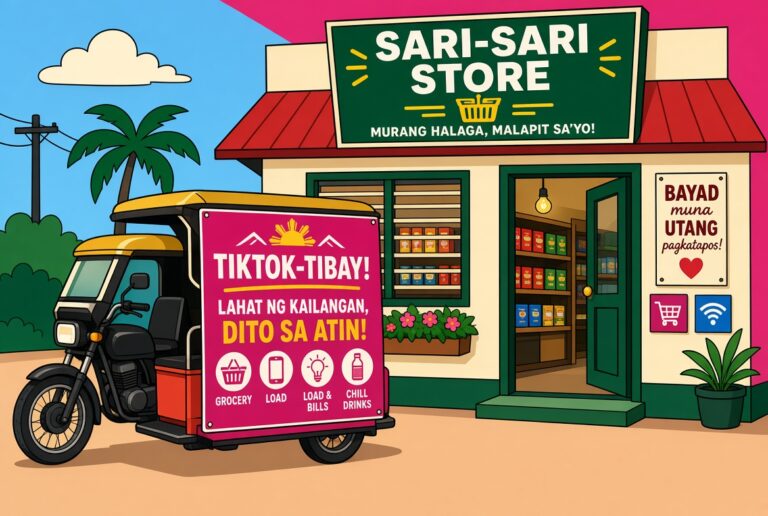
On a weekday morning in Quezon City, a merchandiser walks into a sari-sari store in Batasan to check the wall. The owner has met three people from three brands this month. She remembers the one in the polo that matched the fascia outside.
An embroidered polo does not sell the product. It tells the store owner, and everyone at the grille, that the person checking the wall belongs to the brand on the wall.
The people at the wall should look like the wall.
Short answer: if your campaign has merchandisers, sampling crews or barkers who visit wall stores in Quezon City, put them in embroidered polos or vests in the campaign colors, and give the tindera behind the counter an embroidered cap. Embroidery survives the daily washing that a work uniform gets, and it reads as staff, not giveaway. If nobody from your side ever visits the stores, skip uniforms and spend on walls.
Why the crew is part of the media
A sari-sari wall works from the street. But a wall campaign is not only the wall. Someone scouts the store, someone installs the fascia, someone comes back to photograph it, fix a torn corner and talk to the owner about renewal. In our notes on the wall that still sells, the point is that small-store walls work because they sit where people actually buy. The crew is how the brand shows up at that same spot in person.
When that crew wears whatever they had on that morning, the owner has to take their word that they are from the brand. When they wear a polo in the wall’s colors with the logo stitched on the chest, the question answers itself. That makes the photo visit quicker, the maintenance talk easier, and the renewal less of a cold call.
There is a second audience: buyers at the grille. A sampling crew in matching vests beside a matching wall looks like an organized promo, not three strangers with a cooler.
Embroidery or print for staff wear
| Embroidery | Printed logo (DTF or silk screen) | |
|---|---|---|
| Look | Raised, stitched; reads as company uniform | Flat; reads as event or giveaway shirt |
| Washing | Holds up through frequent washing | Good prints last, but cracking and fading show over time |
| Best on | Polos, caps, vests, jackets | T-shirts, large back prints |
| Detail | Small logos and simple shapes; fine text gets lost | Full color, photos, fine text |
| Setup | One-time digitizing of the logo | None for DTF; screens for silk screen |
| Fits a wall campaign as | Crew and tindera uniforms worn for months | Launch-day and crowd shirts |
Rule of thumb from the desk: if the garment will be worn several times a week for the length of the contract, stitch it. If it will be worn at one event, print it.
ADROOM desk ranges for a Quezon City crew
- Sari-sari wall rent, Quezon City residential barangays: ₱1,800–₱2,800 per wall per month, before production. That matches the NCR residential range in what a sari-sari fascia costs in 2026. Corners near a school gate or public market carry the premium described there.
- Embroidered polo, with a chest logo: ₱450–₱850 per piece at about 24 to 100 pieces, depending on fabric and stitch count.
- Embroidered cap: ₱180–₱350 per piece at similar quantities.
- Merchandiser vest with embroidered or printed logo: ₱350–₱650 per piece.
- Logo digitizing for embroidery: a one-time ₱500–₱1,500 per design, reused on every later order.
These are ADROOM desk ranges: indicative planning numbers, not an official rate card. Your quote depends on garment quality, logo size, number of thread colors, sizes and delivery, and it comes in writing before anything is stitched.
Worked example: thirty walls and four merchandisers
A sachet coffee brand runs thirty sari-sari walls in Quezon City for three months, spread across barangays around Commonwealth, Batasan Hills, Novaliches and Project 4. At the desk range that is ₱54,000–₱84,000 in rent per month, before production on each new wall.
Four merchandisers cover the thirty stores on a weekly loop. The desk sketches the uniform line like this:
- Twelve embroidered polos, three per merchandiser so there is always a clean one: ₱5,400–₱10,200.
- Thirty embroidered caps for the tinderas in each wall store, handed over by the merchandiser on the first visit: ₱5,400–₱10,500.
- One digitizing fee for the logo: ₱500–₱1,500.
Total: about ₱11,300–₱22,200 for the full three months, against ₱162,000–₱252,000 in rent over the same period. Depending on where each falls in its range, the uniform line lands between roughly 4% and 14% of the rent line. And unlike rent, the polos and the digitized logo carry over to the next campaign.
If the brand adds a sampling weekend, four vests for the sampling crew add ₱1,400–₱2,600. Those can be printed instead of stitched if they will only be worn a few times.
Who this is for, and who should skip it
It is for brands that have people visiting wall stores on a schedule: merchandisers, auditors, sampling teams, sales reps who check stock. It also fits distributors whose sub-dealers handle walls for several brands, where a matching polo is the simplest way to say which brand this visit is about.
Skip it if your walls are installed and photographed by a crew you never see and nobody from your side visits. Skip the tindera caps if the owners are not expecting them; a cap given without a word reads as a promo item, not a thank-you. And never put an embroidered uniform on someone who is not actually working for the campaign. A polo with your logo is a promise about who that person represents.
Mistakes we see
- A logo too detailed to stitch. Fine gradients and small text blur in thread. Ask the desk for an embroidery version: simplified shapes, the brand name large enough to read across a counter.
- Uniform colors that fight the wall. If the fascia is red and yellow, a navy polo with a white logo is a different brand. Match the main color, or at least the logo color.
- One polo per person. A merchandiser on a weekly loop needs two or three, or the uniform stops being worn by Wednesday.
- Ignoring the heat. A thick polyester polo in a Quezon City afternoon gets swapped for a t-shirt. Choose a breathable fabric for crews who walk between stores.
- Ordering before the crew size is fixed. Uniforms are sized per person. Confirm names and sizes, then send the order.
The uniform checklist
- Who visits the wall stores, and how often?
- How many people, in what sizes, and how many pieces each?
- Do the polo color and logo match the fascia?
- Does the logo have a version that stitches cleanly?
- Will the merchandiser hand the tindera caps over in person, with a word of thanks?
The items the desk produces from wall artwork, from embroidery to event kits, are listed on the ADROOM homepage in the hand-out section. You can send a brief with walls and crew uniforms on one quote.
In Quezon City, ADROOM pairs sari-sari fascias with embroidered polos, caps and vests in the campaign colors, so the merchandisers and tinderas who stand at the wall carry the same brand as the wall.