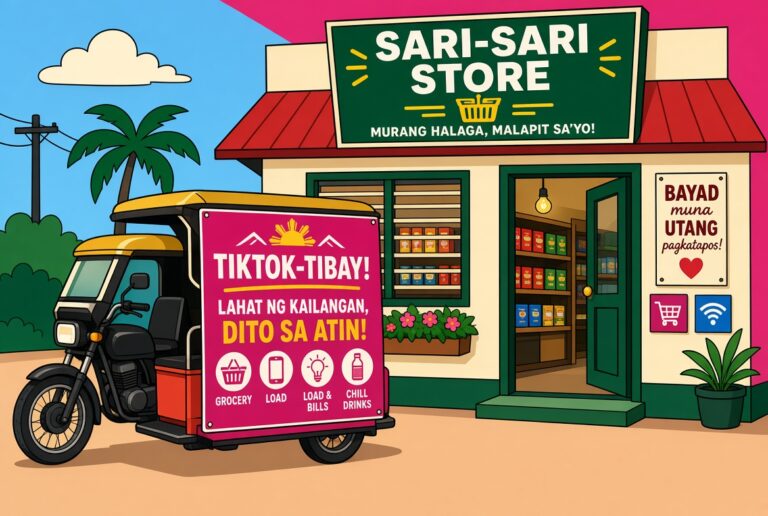
Two days before a wall launch in Davao City, the brand manager asks for “shirts for the stores.” Nobody has said how many, for whom, or in how many colors. Those three answers decide the print method, and the print method decides the price.
Direct-to-film is the right shirt for a small, many-colored run with names. Silk screen is the right shirt for a big, one- or two-color run. Picking the wrong one costs more than the shirts.
Count the people first. Then pick the press.
Short answer: if the shirts are for the store owners and the barkers on your wall list, a few dozen pieces in full color, order direct-to-film (DTF). If the shirts are for a launch where you hand out a few hundred to shoppers or a sampling crowd, and the artwork can be cut down to one or two flat colors, order silk screen. Either way, print from the same artwork as the fascia so the shirt and the wall read as one campaign.
DTF or silk screen: what each method is good at
Both methods put your logo on cotton. They get there differently, and that difference shows up in your quote.
Direct-to-film prints the full artwork onto a film, then heat-presses it onto the shirt. There is no screen to make, so the first shirt costs about the same as the twentieth. Photos, gradients and many colors cost nothing extra. You can change a name or a size on every piece. The trade-off is that the price per shirt does not fall much as quantity grows.
Silk screen pushes ink through a stencil, one screen per color. Making the screens is a fixed cost you pay once, so ten shirts are expensive and three hundred are cheap. It handles bold, flat colors well and holds up through a lot of washing. It is not the method for a photo of your product or a different name on every back.
| Direct-to-film | Silk screen | |
|---|---|---|
| Best quantity | Roughly 10 to 100 pieces | Roughly 100 pieces and up |
| Colors | Full color, gradients, photos | One or two flat colors works best |
| Setup | None to speak of | One screen per color, paid once |
| Names or numbers per shirt | Easy | Awkward and costly |
| Typical use in a wall campaign | Store owner and barker shirts | Launch-day hand-outs and sampling crowds |
| What goes wrong | Paying DTF prices for 400 shirts | Paying for screens to print 15 shirts |
The quantities in that table are a desk rule of thumb, not a hard line. Where the switch falls depends on how many colors the artwork needs and how big the print is.
ADROOM desk ranges for a Davao City run
- Sari-sari wall rent, Davao City barangays: ₱1,400–₱2,800 per wall per month, before production. This is the same range we publish for Cebu, Davao and Iloilo centers in what a sari-sari fascia costs in 2026.
- DTF shirt, plain cotton tee with one full-color front print: ₱280–₱480 per piece at about 10 to 50 pieces.
- Silk screen shirt, plain cotton tee with a one-color front print: ₱160–₱300 per piece at about 100 to 300 pieces, plus a one-time screen setup of ₱500–₱1,500 per color.
These are ADROOM desk ranges: indicative planning numbers, not an official rate card. Your quote depends on the shirt fabric, print size, number of colors, sizes ordered and delivery, and you get it in writing before anything goes to the press.
Worked example: twenty-five walls and one launch Saturday
A powdered-drink brand puts up twenty-five sari-sari walls across Davao City, spread through barangays in Buhangin, Matina, Toril and the streets around Bajada, for a 30-day run. At the desk range, rent comes to ₱35,000–₱70,000 for the month, plus production for each new wall.
The brand wants shirts for two different groups, and the desk splits them into two orders.
- The store crew. One shirt for each owner and one for the person who barks for the promo out front: fifty shirts, in the full-color wall artwork, some with the store’s name printed small on the sleeve so the owner knows it was made for her. This is a DTF job. Fifty pieces at ₱280–₱480 is ₱14,000–₱24,000, with no screens to pay for.
- The launch Saturday. A sampling table at a barangay covered court, with a shirt for anyone who buys a bundle. The brand expects to hand out three hundred. The wall artwork has a photo of the drink, so the desk rebuilds a one-color version: the logo and the tagline in the brand’s main color on a white shirt. That is a silk screen job. Three hundred pieces at ₱160–₱300 is ₱48,000–₱90,000, plus one screen.
Notice what happened. If the brand had ordered all 350 shirts as DTF, the three hundred launch shirts alone would come to ₱84,000–₱144,000 at the DTF range, against ₱48,000–₱90,000 as silk screen. If it had ordered all of them as silk screen, it would have paid for screens and still lost the photo and the store names that make the crew shirts worth wearing. Splitting the order by who wears the shirt is where the money is saved.
Who this is for, and who should skip it
It is for brands whose wall stores have an owner or helper who calls out to buyers, brands running a launch day or sampling event in the same month as the walls, and brands with a merchandiser who visits stores in person. A shirt handed over by someone the owner knows gets worn. A shirt in a courier bag often does not.
Skip it if the product is not stocked yet in the wall stores; a shirt for a drink nobody can buy there is a souvenir. Skip the launch run if you have no event booked. And skip both if the budget only covers a handful of walls. Walls first, shirts second.
Mistakes we see
- Shrinking the wall layout onto a chest print. A fascia is designed to be read from across the street. On a shirt, the product name disappears. Rebuild it: logo and product name large, one short line, nothing else.
- Ordering one size for everyone. Ask for a size count per store. A shirt that does not fit goes to a cousin in another town, which is nice for the cousin and useless for your street.
- Too many colors for silk screen. Every extra color is another screen and another pass. If the artwork needs five colors, it is a DTF job or it needs a simpler design.
- Printing before the store list is final. Owners change their minds and landlords repaint. Lock the walls, then print the names.
- Thin shirts. A shirt that goes see-through after three washes tells the barangay something about your brand. Pay for a decent fabric weight.
The shirt checklist before you send the brief
- Who wears each shirt: store crew, sampling crowd, or both?
- How many pieces in each group, and what sizes?
- Does the artwork need full color, or can it be cut to one or two flat colors?
- Is there a dated event for the volume run?
- Will someone hand the crew shirts over in person, at the store?
If two groups come out of that list, ask for two orders on one quote. The full list of items the desk prints from wall artwork is on the ADROOM homepage, in the hand-out section, and you can send a brief with walls and shirts on one sheet.
In Davao City, ADROOM pairs sari-sari fascias with direct-to-film shirts for the store crew and silk screen shirts for launch-day crowds, printed from the same wall artwork so the street and the shirt carry one brand.