The owner of a corner store in Pasig drinks her first coffee at six, before the bread arrives. Whatever mug she holds, the whole counter sees.
A fascia gets your brand seen from the street. A mug the owner actually uses puts your brand at the counter, where the sale is decided.
The wall starts the look. The item finishes the sale.
Short answer: a fascia plus a mug beats a fascia alone when the mug goes to the people who stand behind the counter, the owner and the helpers who answer “ano’ng meron?”, and when it carries the same artwork as the wall. In that case you pay for one extra item and get a second, closer view of the same brand every day. If you cannot name who gets the mugs, skip them and put the money into more walls.
What the wall does, and where it stops
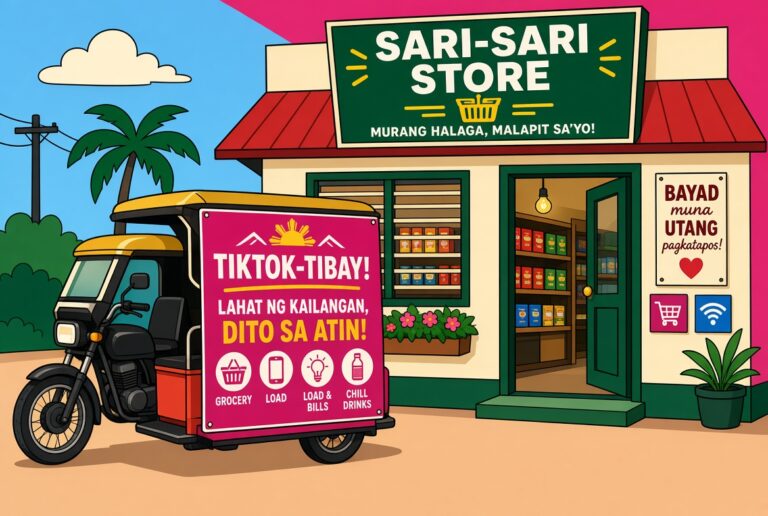
A sari-sari fascia does one job very well. It tells everyone walking or riding past that your brand lives at this store. It works at a distance of a few meters to half a block, and it works all day, rain or shine, for as long as the lease runs. Nothing else at that price reaches the same street that steadily.
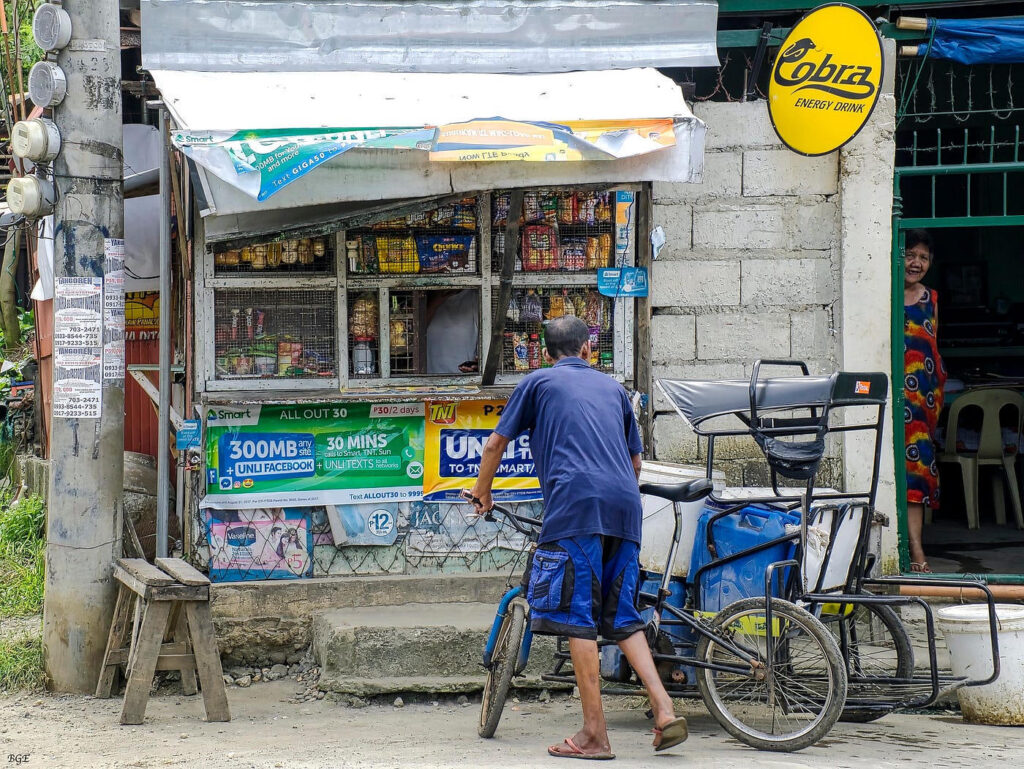
But the wall is silent at the moment that matters most. A lot of small-store buying is not decided at the shelf, because there often is no shelf the buyer can reach. The buyer stands at the grille and asks. The owner, or her nephew minding the store after school, answers. If the buyer says “kape, yung masarap,” the answer comes from whoever is standing behind the counter, and the wall outside cannot raise its hand.
That is the gap the giveaway is meant to close. Not more reach, but presence at the window where the conversation happens.
What a mug does that the wall can’t
A printed mug on the counter does three things a wall does not.
- It sits inside the store. The wall faces out. The mug faces the buyer at the grille, at arm’s length, during the exact minute they are choosing.
- It is used by the person who recommends. The owner sees your logo every morning. That is not a statistic; it is just where the mug lives. People tend to name the brands that are already in their hands.
- It is a thank-you the owner remembers. Your field rep comes back for the proof-of-presence photo and the wall maintenance. A store owner who received something useful is easier to talk to about a torn corner or a better angle for the light.
None of this works with a cheap mug. A chipped mug with your logo on it is an ad for chipping. Spend on a decent ceramic with a clean print, and tell the owner to hand-wash it. Sublimation prints hold up best that way.
Worked example: twelve stores in Pasig
A 3-in-1 coffee brand wants twelve walls in residential barangays in Pasig, around Caniogan, Manggahan and Santolan, for three months. Here is how the ADROOM desk would sketch it.
- Wall rent: ₱1,800–₱2,800 per wall per month for NCR residential barangays. Twelve walls for three months is 36 wall-months, so ₱64,800–₱100,800 in rent before production.
- Mugs: six per store (one for the owner, the rest for helpers and the regulars who sit on the bench outside), plus spares for breakage. Call it 100 printed 11 oz mugs at ₱80–₱150 each, or ₱8,000–₱15,000.
These are ADROOM desk ranges: indicative planning numbers, not an official rate card. The wall figures match the ranges we publish in what a sari-sari fascia costs in 2026. The mug range is built from public print-shop listings for sublimated mugs at quantities of 50 to 500, checked in October 2026. Your quote depends on quantity, print area, packaging and delivery, and it comes in writing before anything is printed.
Read the numbers this way: the mug line lands somewhere between about 8% and 23% of the rent line, depending on where each falls in its range. For that, every one of the twelve stores gets your brand behind the counter, not just on the front.
| Fascia alone | Fascia plus mug | |
|---|---|---|
| Who sees it | Everyone passing the store | Passers-by, plus the owner and buyers at the grille |
| Where | Outside, at street distance | Outside and at the counter, at arm’s length |
| How long | For the length of the lease | Lease, plus however long the owner keeps using the mug |
| Proof | Geotagged photo of the wall | Wall photo, plus a counter photo if the owner agrees |
| Extra cost in the example | None | About 8–23% of the rent line (desk range) |
| What can go wrong | Faded print, blocked view | Mugs that never leave the distributor’s warehouse |
Who this is for, and who should skip it
It is for brands that are sold over the counter and recommended out loud: coffee, snacks, condiments, sachet detergent, load. It also fits brands with a field rep or merchandiser who actually visits each store. That visit is where the mug gets handed over, and where it gets noticed again later.
Skip it if your product is not yet stocked in the stores where the walls go. A mug for a product the buyer cannot get is a souvenir, not a sale. Skip it if your budget only stretches to a handful of walls; walls first, items second. And skip it if the only way mugs reach the store is in a box dropped at a distributor. Boxes like that have a way of staying boxes.
Mistakes we see
- Different artwork on the mug. The point is a second view of the same face. If the wall is yellow and the mug is navy with a different tagline, the buyer sees two brands.
- A logo too big for the mug. Mugs have a small safe print area. A wall layout shrunk down usually loses the product name. Lead with the product and the color, not a slogan.
- Ordering mugs before walls are confirmed. Walls move: an owner changes her mind, a landlord repaints. Lock the store list first, then print.
- Giving to everyone. Fifty mugs at a barangay event spread thin. Six at each store you rent reach the people who talk to buyers.
- Not telling the owner what it is for. Say it plainly: “Para sa inyo ito, salamat sa pader.” A thank-you lands better than a sales pitch.
A five-question check before you add the mug
- Is the product stocked in every store on the wall list?
- Do we know who stands behind each counter, by name or at least by role?
- Will a person, not a courier box, hand over the mugs?
- Does the mug use the wall’s colors and product name, at a size you can read across a counter?
- Is the mug line small next to the rent line, so it does not cost us walls?
Five yeses: add the mug. Two or more nos: fix those first, or keep the budget in walls.
If you are already planning walls with us, the hand-out options on our homepage list what our desk can produce from the same artwork. To put a mug line next to your wall list, add it to your brief and we will quote both in one sheet.
A wall makes a brand visible from the street. A mug in the store owner’s hand makes it present at the counter, and the counter is where the small-store sale is decided.